Care Coordination Platform (ABA Therapy)
HEALTHCARE
Helps staff assign therapists to patients faster with less manual effort.
Before

After
After
Care Coordination Platform (ABA Therapy)
HEALTHCARE
Helps staff assign therapists to patients faster with less manual effort.
Before
After
After
Teamwork Healthcare is a care coordination platform used by staff to manage therapist assignments, scheduling, and in-home ABA therapy delivery across New York.
Teamwork Healthcare is a care coordination platform used by staff to manage therapist assignments, scheduling, and in-home ABA therapy delivery across New York.
01 OVERVIEW
01 OVERVIEW
My Role
My Role
Team size
Team size
Project Timeline
Project Timeline
UX designer
UX designer
12
12
9 months
9 months
Where the workflow breaks
Where the workflow breaks
Assigning the right therapist to each patient was manual, slow, and difficult to scale.
Assigning the right therapist to each patient was manual, slow, and difficult to scale.
USER PROBLEM
BUSINESS PROBLEM
The matching workflow forced staffers to manually scan long, unstructured therapist lists with no way to quickly compare qualifications, availability, or location against client needs.
Manually reviewing large lists of therapists
Difficulty comparing qualifications and availability
High cognitive load when making decisions
The matching workflow forced staffers to manually scan long, unstructured therapist lists with no way to quickly compare qualifications, availability, or location against client needs.
Manually reviewing large lists of therapists
Difficulty comparing qualifications and availability
High cognitive load when making decisions
Every hour spent on manual matching was an hour a child waited for a therapist. Poor matches led to reassignments, gaps in care, and reduced staff productivity.
Slow matching process delayed patient care
Poor matches led to reassignments and inefficiencies
Reduced platform effectiveness and staff productivity
Every hour spent on manual matching was an hour a child waited for a therapist. Poor matches led to reassignments, gaps in care, and reduced staff productivity.
Slow matching process delayed patient care
Poor matches led to reassignments and inefficiencies
Reduced platform effectiveness and staff productivity
02 THE PROBLEM
02 THE PROBLEM
Staffers couldn't match efficiently
Staffers couldn't match efficiently
Slow matching = delayed patient care
Slow matching = delayed patient care
03 WHO IS FOR
PRIMARY USER
SECONDARY USER
OUT OF SCOPE
The people who match therapists to clients daily. They own the
workflow — every design decision was made for them first.
The therapists who travel to clients. They need clear schedules and smooth onboarding to new clients — but don't drive the matching decision.
They receive the outcome of a good match but don't interact with the matching platform. Progress tracking for caregivers was deprioritized to a later release.
Caregivers / Families
Behavior Therapists (BTs)
Staffers / Coordinators
03 WHO IS IT FOR
PRIMARY USER
SECONDARY USER
OUT OF SCOPE
The people who match therapists to clients daily. They own the
workflow — every design decision was made for them first.
The therapists who travel to clients. They need clear schedules and smooth onboarding to new clients — but don't drive the matching decision.
They receive the outcome of a good match but don't interact with the matching platform. Progress tracking for caregivers was deprioritized to a later release.
Staffers / Coordinators
Behavior Therapists (BTs)
Caregivers / Families
04 WHAT WE WANT TO BUILD
04 WHAT WE WANT TO BUILD
A platform that helps staffers find the best match between therapist and client — faster, with less effort, and with fewer mistakes.
A platform that helps staffers find the best match between therapist and client — faster, with less effort, and with fewer mistakes.
PROJECT GOAL
PROJECT GOAL
Research → 3 core findings
Research → 3 core findings
We identified 3 key issues blocking efficient matching:
We identified 3 key issues blocking efficient matching:
05 HOW WE KNEW
01
01
02
03
02
03
Staffers saw long, unranked lists of therapists with no signal about who was the best fit. Every name required the same manual evaluation effort.
Staffers saw long, unranked lists of therapists with no signal about who was the best fit. Every name required the same manual evaluation effort.
Key data — availability, specialization, location — was scattered across multiple views. Staffers opened multiple tabs to build a complete picture of one therapist.
Key data — availability, specialization, location — was scattered across multiple views. Staffers opened multiple tabs to build a complete picture of one therapist.
Matching required excessive manual comparison and mental effort. There was no way to view multiple therapists side-by-side against a client's requirements.
Matching required excessive manual comparison and mental effort. There was no way to view multiple therapists side-by-side against a client's requirements.
No clear prioritization in the list
No clear prioritization in the list
Fragmented information across screens
Fragmented information across screens
Manual decision-making with no comparison tool
Manual decision-making with no comparison tool
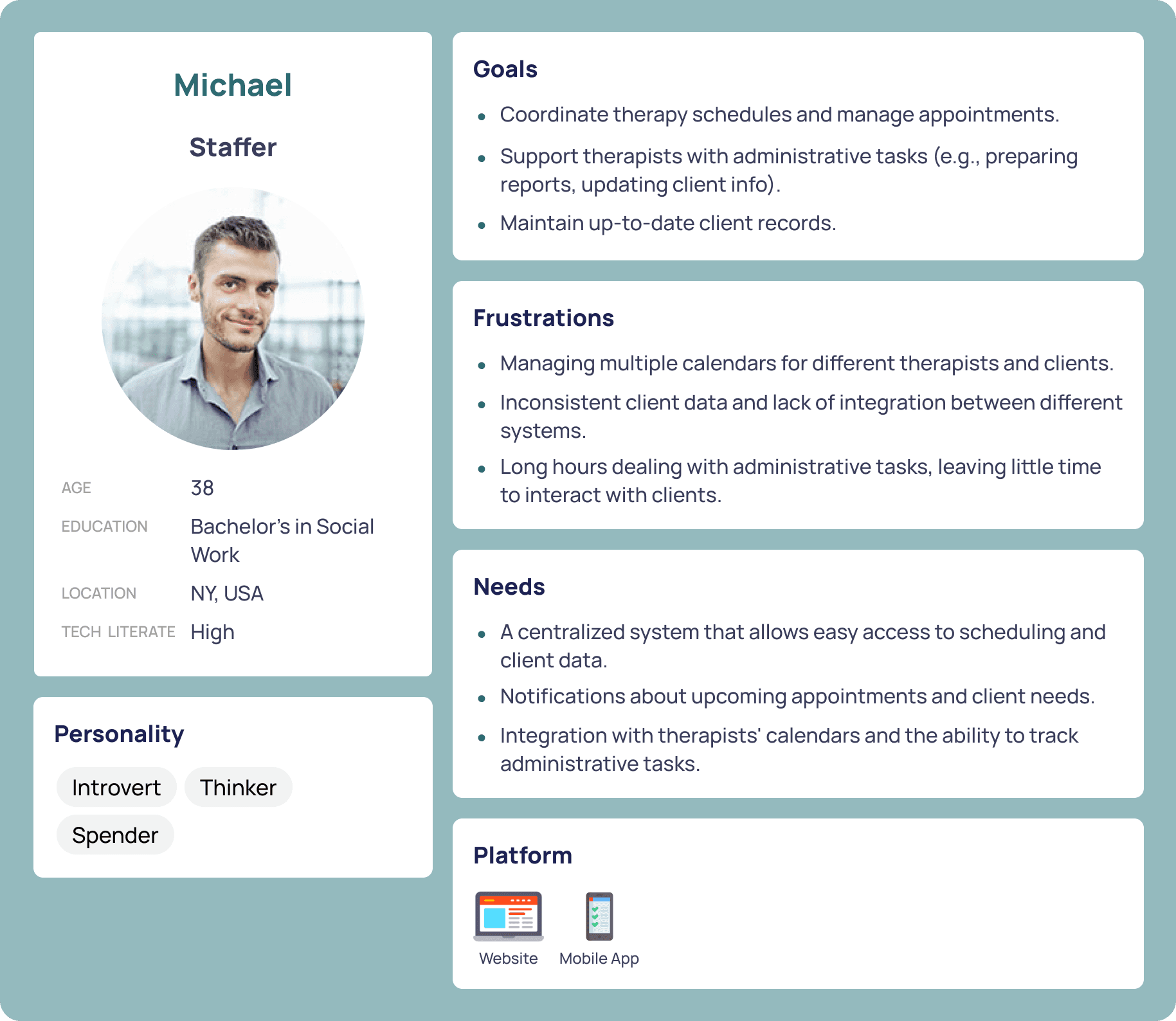
Built from interview synthesis — this persona kept every design decision grounded in real staffer behavior.
Built from interview synthesis — this persona kept every design decision grounded in real staffer behavior.
RESEARCH ARTIFACTS 01 USER PERSONA
RESEARCH ARTIFACTS 01
USER PERSONA
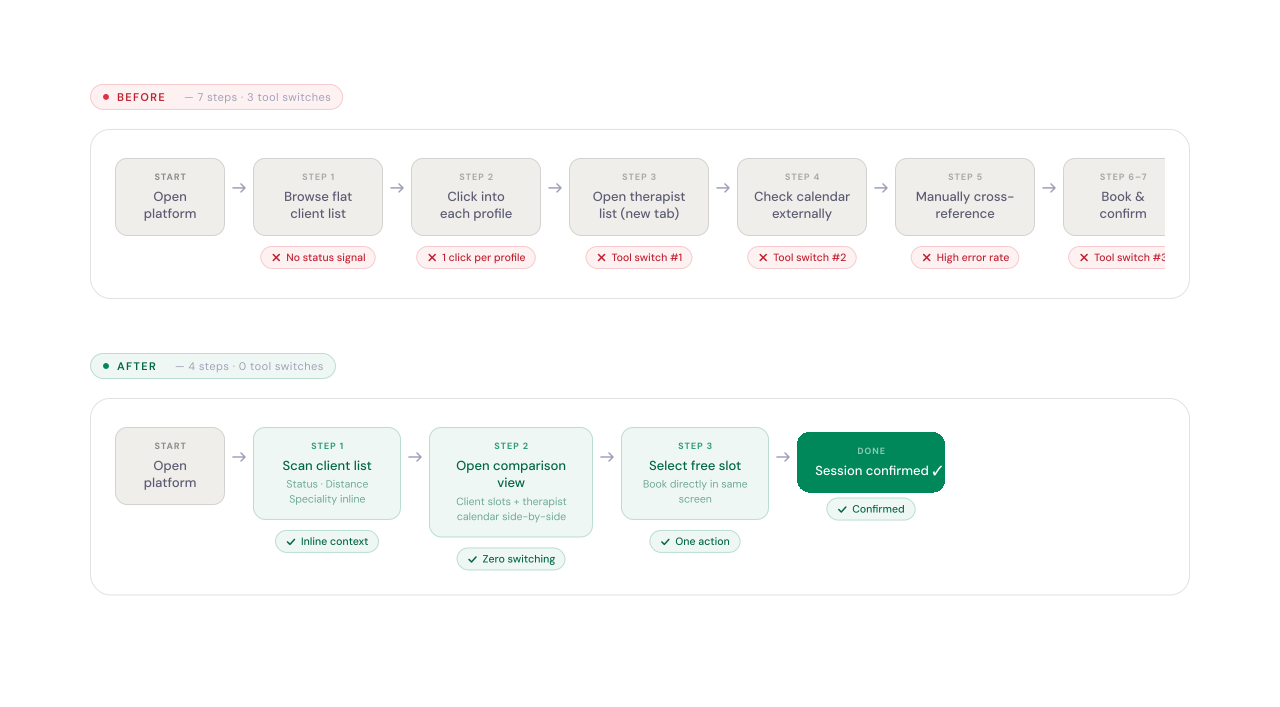
Mapped the existing flow to expose where staffers lost context or had to switch tools. Each step shows the actual screen they had to open.
Mapped the existing flow to expose where staffers lost context or had to switch tools. Each step shows the actual screen they had to open.
RESEARCH ARTIFACT 02 USER FLOW - MATCHING A CLIENT
RESEARCH ARTIFACT 02
USER FLOW - MATCHING A CLIENT
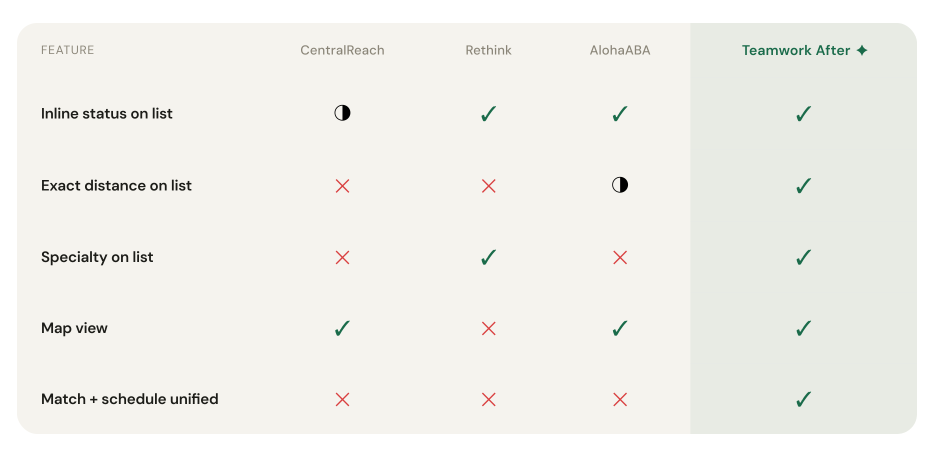
We looked at how 3 leading ABA platforms handle the client list — the same screen staffers use daily. Each one had gaps. Those gaps defined what we had to build.
We looked at how 3 leading ABA platforms handle the client list — the same screen staffers use daily. Each one had gaps. Those gaps defined what we had to build.
RESEARCH ARTIFACTS 03 COMPETITOR ANALYSIS
RESEARCH ARTIFACTS 03 COMPETITOR ANALYSIS
06 PRIORITIZATION
Why the matching workflow came first
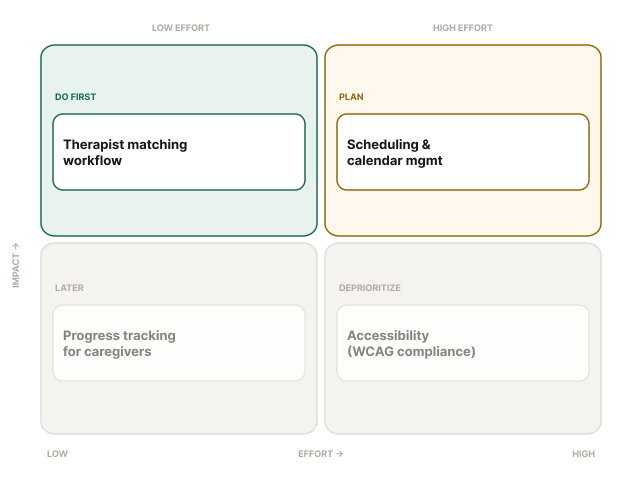
Why the matching workflow came first
We focused on improving the matching workflow because it was the core daily task — and the one with the highest impact on both care delivery speed and operational friction.
We focused on improving the matching workflow because it was the core daily task — and the one with the highest impact on both care delivery speed and operational friction.
07 CHALLENGE 1
What I tried, and what didn't work
What I tried, and what didn't work
No therapist
No specialty
No sorting
No distance
No map
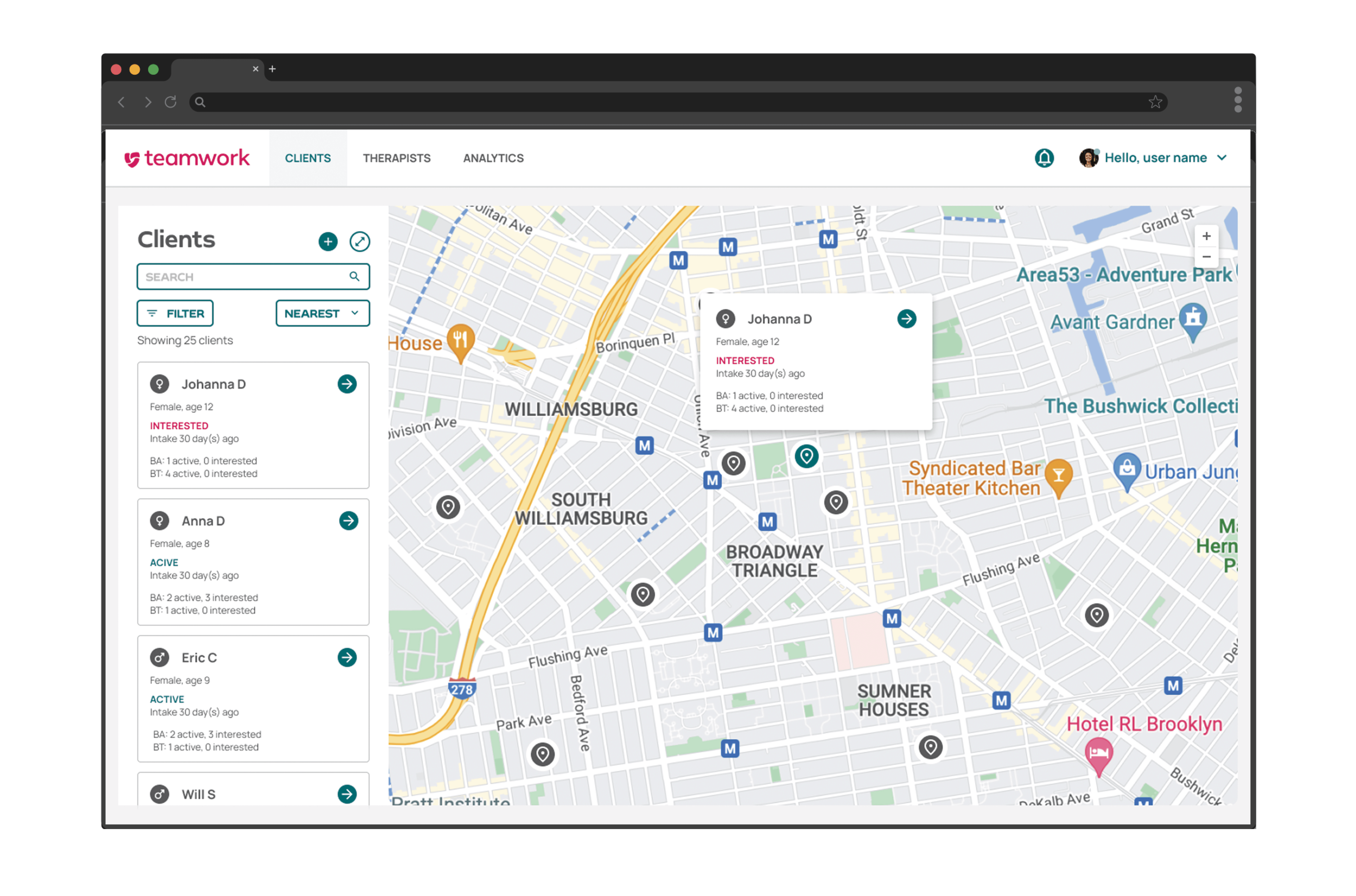
Key learning: Staffers needed information on the list — not more filters. Every iteration moved data closer to the row and removed clicks.
Key learning: Staffers needed information on the list — not more filters. Every iteration moved data closer to the row and removed clicks.
Before
Before
Iteration 1 — Added map + sorting
Iteration 1 — Added map + sorting
After - Shipped
After — Shipped
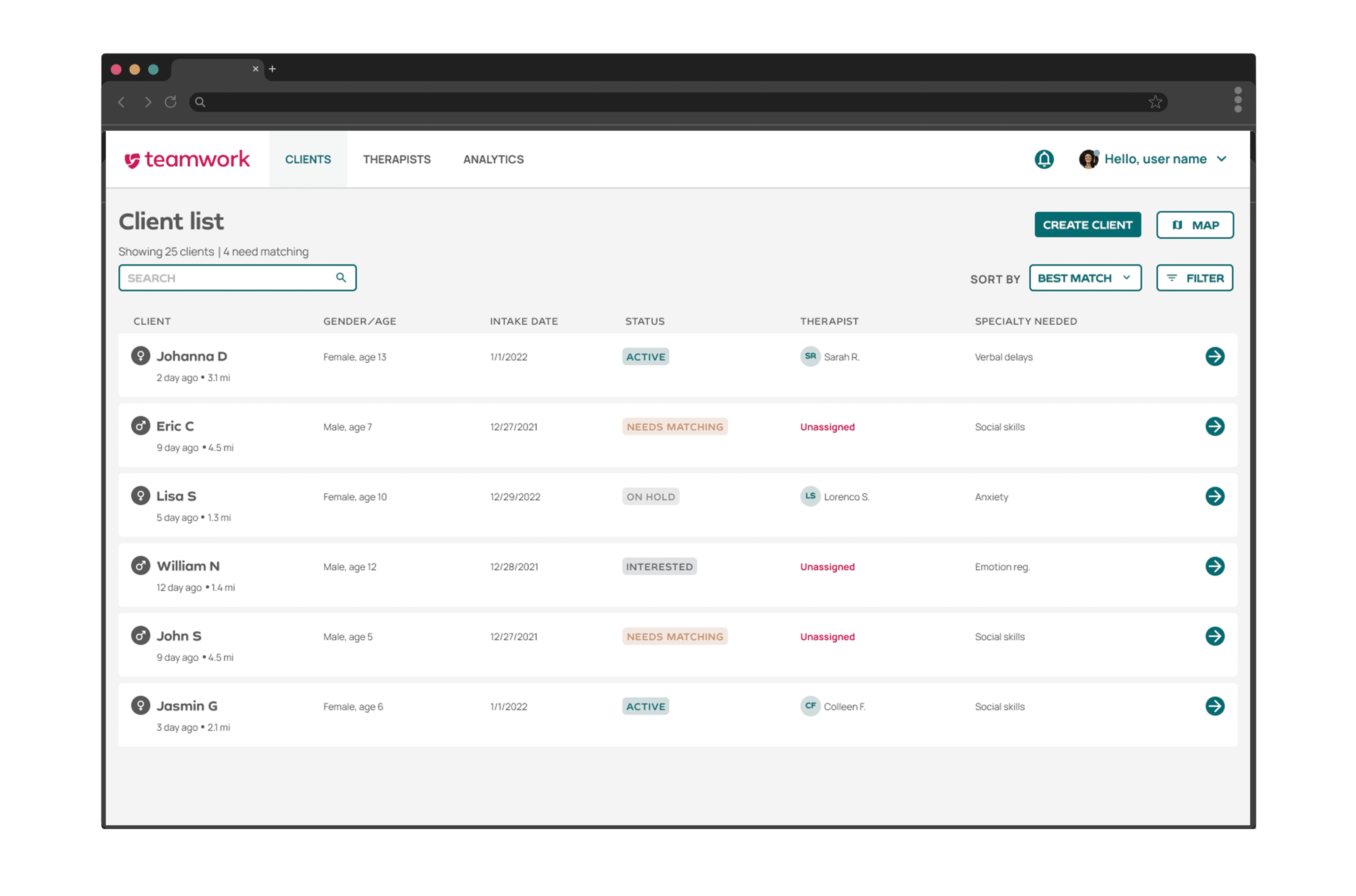
Problem — before redesign
4–6 clicks per client before a decision. Therapist, specialty, and distance were all hidden behind individual profile pages.
After — confirmed in testing
All key data visible at a glance. Matching decisions dropped from 6 clicks to 1 — confirmed across 3 usability sessions.
"I have to open every card just to find out who's assigned"
"I can see everything I need without clicking in"
No therapist
No specialty
Add Map
Add Sorting
Best matches
Therapist visibile
Add specialty
Column titles
Distance Inline
08 CHALLENGE 2
Scheduling lived in a separate tool
Matching and scheduling were completely disconnected
Availability doesn’t scale
Missing assignment context
Compare therapist availability
Client info is visible
Create appointment directly from calendar
Compare multiple therapists instantly
Schedule visible without opening another tool
Therapist list stays visible


After matching a client, staffers had to open a completely separate calendar to check availability and book — losing all the context they just gathered. The tools didn't talk to each other.
Problem — 3 tool switches per booking
Iteration 1
Iteration 2
Staffers matched a client in Teamwork, opened Google Calendar in a new tab to find a free slot, then returned to Teamwork to confirm. Every booking required 3 context switches and frequent errors from lost state.
Teamwork — Client profile
Find the client, check what therapy they need
Google Calendar
Find a free slot — no client context visible
Teamwork — back to confirm
Re-enter the slot manually — frequent errors
Tab 1
Tab 2
Tab 3
Result: Staffers lost context every time they switched tabs. Double-bookings and missed availability conflicts were the most common scheduling errors reported in interviews.
What didn't work: Staff could compare schedules, but still needed to mentally connect availability back to therapist assignment.
Key Insight: Staff didn’t need a better calendar.
They needed scheduling integrated into the decision flow.
What we tried first
Tested with 3 staffers. Key question: would seeing client info + calendar in one view actually reduce booking errors?
08 CHALLENGE 2
Scheduling lived in a separate tool
After matching a client, staffers had to open a completely separate calendar to check availability and book — losing all the context they just gathered. The tools didn't talk to each other.
Matching and scheduling were completely disconnected
Problem — 3 tool switches per booking
Problem — 3 tool switches per booking
Staffers matched a client in Teamwork, opened Google Calendar in a new tab to find a free slot, then returned to Teamwork to confirm. Every booking required 3 context switches and frequent errors from lost state.
Teamwork — Client profile
Find the client, check what therapy they need
Google Calendar
Find a free slot — no client context visible
Teamwork — back to confirm
Re-enter the slot manually — frequent errors
What didn't work: Staff could compare schedules, but still needed to mentally connect availability back to therapist assignment.
Iteration 1
What we tried first
Iteration 2
Key question: would seeing client info + calendar in one view actually reduce booking errors?